Saturday, October 6, 2018

Towards a theology of animal welfare


One of the most difficult groups of people I've ever had to interact with when it comes to animal welfare and animal rights are those of Christians or of a Judaeo-Christian background.  As I am a Christian I can identify easily where they are coming from.  I was once there myself.  But I also have to admit that I've become frustrated with the typical (almost identical) responses I get from others and how to deal with them.  The basic responses I get to the discussion of animal abuse, meat eating and animal rights are along the lines of:

"But that is what God put them on earth for", or,

"Animals aren't equal with humans".

These two responses represent two categories that really need to be dealt with as they relate to the relationship of humans with animals in order for our answers to even be considered acceptable to the Christian (I am speaking here to Christians, but I believe the same thing is true for Jews, Muslims and other religions).

The first statement really has to do with creation and God's relationship to man, not really man's relationship to animals per se.  The answer will definitely effect our relationship to animals, but that isn't the primary basis for an answer to this statement.  We need to be able to answer (or ask questions) about God's relationship to man and the initial creation of man and his world and once that is done we will be better able to answer or ask questions about man's relationship to the animals.

The second statement concerns anthropology.  On the surface it looks like it is talking about animals.  But it is not. It is talking about humans. That is, who is man to God and how does that effect animals.  I realize that my atheist friend might wish to start an answer based on whether or not animals are equal with man, but with a Christian such an argument probably isn't going to go very far (covered in the last section).  With any argument it is always important to know your audience and interact in a way they will understand and respond to, having accurate knowledge of both what you are trying to say and confidence that you are understanding the questions they are trying to ask.

One final note.  This post is not  about how to twist a Christian's arm into becoming an animal welfare activist or a vegan or what have you. It is about understanding.  Understand where others are coming from, understanding how to ask real questions and give real answers and, probably more than anything, helping me to understand the theological ramifications of what I believe. And like any interaction with humans, things are going to be in flux as ideas are thrown in, turned over, looked at and rejected or accepted.  In other words, what is said here is not the final word on the subject.  Not even close.

"But that is what God put them on earth for"

Let me first start by pointing out in answer to this particular statement, most Christians haven't a clue why they are saying this.  They know that somewhere the Bible must say this, but they don't know where and they certainly are likely not to know why it is said if it does say such a thing.  The fact is, the Bible does say such a thing.  I won't list all of the biblical passages where this is formulated, but the most important would be Genesis 9:3:
Every moving thing that is alive shall be food for you; I give all to you, as I gave the green plant." (NASB)
It really is difficult to argue against this passage.  I've heard attempts at it, but all of them appear to me to be anemic.  The passage says what it says and there is no reason to believe it means anything other than what it means.

However, to understand this passage I think it is important that we look at everything that came before it.  This passage says "...as I gave the green plant".  If we read the first couple chapters of Genesis we discover that man didn't start out eating animals.  In Genesis 2:15-16 we see that man's job was to tend the garden and that he may eat of any try except one. No where in these two chapters that deal with humans, creation and God are we told they may eat animals.  In fact, it s commonly held that man and woman were vegans at the beginning of creation.

[As a quick side note, some might argue for a mythological-poetic reading of the first few chapters of Genesis whereas I've taken a  more literal approach.  I am not taking one side or the other here as I believe either reading will end with the same conclusion I've here stated. That is, that humankind started out, according to the Bible and the Christian religion, consuming a plant based diet.]

So when it comes to answering questions about why animals were created, we have to point out that it wasn't for food.  Or, more importantly, they were not required for food.

Another interesting development are verses 18-25 in chapter two.  It first tells us that God didn't think it was good for man to be alone.  So he tries to find him a companion.  First God turns to the animals.  He creates all of the animals and basically says, "What do you think?".  But neither God nor man finds a companion suitable to the man and so God gives it another whirl and creates woman.  Here, myth or not, the overall meaning is God created woman to be a co-companion with man.  Period.  But I think it interesting that God doesn't simply jump to creating woman.  He first creates all of the animals and lets man interact with them, looking for that one companion.  I don't believe we should gloss over the fact that God's first mention of animals besides humans had to do with human companionship and not food or potential sacrificial substitutions.  This may not directly tell us what animals were for, but it certainly tells us two things they were not for: a substitute for human companionship and food.  The first point I can't deal with in this post, but the second point is exactly what this post is aiming for.

Some might argue that the point of mentioning animals in the first place, while searching for a companion for man, is to demonstrate unequivocally that animals cannot be a proper companion to man.  In fact, all of Scripture seems to bare this out as there is no mention of human to animal companionship in the way we understand it today. But I tend to read this passage as saying human companionship offers a fullness that cannot be gotten from animals.  If it were forbidding animal companionship I think Scripture would have made this more clear.  Besides zoophilia, which is condemned, Scripture is silent on this matter.  That and the fact that people do find a wonderful amount of companionship from animals, I believe my reading is closer to the intent.

Unfortunately things didn't remain so idyllic.  Humankind decided that, as so often they do, they would be better off doing things there own way and telling God to go take a hike.  This introduced sin into the world.  Sin is simply the word for the concept of humans not doing what they were created for. Or, humans going against their original God-intended nature.  It is a missing of the mark.  And the punishment for that decision was death.  But God didn't want humankind to die.  He loved them.  So God allowed another innocent being to die in their place.  Animals.  We read in chapter four that Able sacrificed an animal to God and Cain offered plants. But God accepted Able's gift and not Cain's.  So, in true human fashion, Cain murdered his brother Able.  But here is where things get sticky.  Why did animals have to die in the place of man?  Why did God accept one and not the other? Why does blood have to be shed in order for sins to be forgiven (Hebrews 9:22)?  Why must people forgive other people without any shedding of blood, yet God demands it in order for him to forgive people?  Etc.

These are all excellent questions, but ones I am not prepared to answer.  I am not prepared to answer them because I don't know the answers.   The only answer I can offer has to do with the New Covenant over the Old.  This is where Christianity has something over other religions. Things didn't remain stagnant.  God sent his only son to be that once-for-all innocent sacrifice for man's sins. Animals took the place of humans, Jesus took the place of the animals on behalf of humans.  No more animals would have to die.  God was restoring man's relationship to himself and, in a way, rolling back all of time to that moment in the garden before mankind had gone their own separate way.  This is where I believe most Christians fail to see one serious effect of the New Covenant: There is no more Old Covenant.  It seems simple enough, but it gets missed all the time.

The old covenant stipulated that a rebellious son was to be stoned, with his parents casting the first stone. It also called for the death of an adulterous woman, witches and homosexuals. It called for the sacrifice of innocent animals for the benefit of man.  And it gave man permission to eat the animals.

Animals were not put here to die for us.  They were put here as co-creations with us, not for food, but for other reasons not stipulated in the creation story.  The sacrifices and food angle did not come about until AFTER man rebelled against God.  And now that Jesus, the once-for-all sacrifice for man, died and rose from the grave, man is restored (or in the process of being restored) to what he was BEFORE the fall.

Am I saying that people are sinning when they eat meat?  No.  But for a Christian I wonder why they would justify eating meat when they certainly wouldn't justify sacrificing animals for their sins, killing homosexuals, adulterous women and witches?  I wonder why they would argue against a plant based diet when that is what humankind ate before the fall?  I wonder why they would insist that God made animals for food when, in fact, it is clear that he did not originally make them for that and that animals as food and sacrificial substitutes only came about after the fall?  In short, the statement "That is what God made them for" is, at worse, a very halfhearted response that is lacking in any real substance and is really only serving as a sort of justification for a behavior that one does not want to change.  At best it should, and does, raise more questions than it answers, as already demonstrated.

Finally, whenever I hear that response my first reaction is to ask them if they know what it is they are saying?   I like to reformulate their statement as such: "God made animals for us to torture, abuse and slaughter so that we can fill our already overstuffed bellies with food we don't even need to survive".  And then I ask them if that is what they mean?

"Animals are not equal to humans"

This is a more difficult statement to deal with.  Mostly because it is thrown out as a statement of fact that, I suppose, is expected to end the discussion.  "Oh, you are right.  Animals aren't equal to humans. I am so glad you reminded me of that, now pass the steak".  But I think it is important that we push back on this one.  Again, like the previous statement, it won't do for us to say, "Yes they are" and move on.  That would be taking the same route as the person giving the above statement.  The fact is, according to the Bible and the Christian faith, they are right.

Man was created in the image of God (Read Genesis 1 and 2 again).  No where are we told that animals were created in God's image.  There is no point in trying to argue differently.  Man holds a very special place in God's universe.  This is God goes to such great lengths to save him from himself.  This is why Jesus came as a human.  This is why animals were sacrificed for humans.  This is why humans were given permission to eat animals and to have dominion over them.  If we are going to enter into this discussion within a Christian framework, we are going to have to deal with those facts as facts and not as optional beliefs.  Anything other than those being facts will change Christianity into something other than what it is and make any sort continuing argument useless.

But my answer to this is simple.  So what?   O.K., so animals are not equal to humans.  So what? Maybe it means that if we have the choice to save a human or an animal, we choose to save the human.  Maybe it means that you focus on the needs of humans first and then animals.  But how does this translate to a universal permission to torture, kill, eat and experiment on them?  Experimentation rarely needs to be done (I won't say never, but it is certainly very rare in this day and age).  We've already established that they are not needed for food, at least not in any industrialized nation.  They certainly are not needed as sacrifice for human sin. Jesus took care of that. So what is the point of making such a statement?

Some would argue for meat eating using aborigines living in the desert where human eatable vegetation is hard to come by. But since the person asking the question is probably not such an aborigine, what is the point?

Some would argue asking, "If you knew that sacrificing an animal would cure cancer, would you do it?".  But as this very unlikely, what is the point?

Some would ask, "If you were stranded on a desert island with only animals, would you eat one?  But we aren't stranded on such an island, so what is the point?  I always want to ask such a person, "If you lived in a land where eatable plants were in abundance, would you stop eating meat?"  Or, answer as my daughter once did, "I would just eat the food the animals were eating".

The "point" really is a red herring.  I realize there is somewhat a point in that if you were willing to eat meat in these circumstances, why not eat meat all the other times.  But this is just a justification on the part of the inquisitor. And an "all or nothing" answer is just another logical fallacy along with that of a red herring. We aren't on a dessert island.  We aren't living in a desert.  We don't have the cure for cancer.  But we do have lots of plants.  We do live in a land of plenty.  We don't need to eat animals.  So really the point is no point at all.  Just like the statement, "Animals aren't equal to humans".

However, I like to reformulate this statement as well.  I think it is being stated incorrectly.  I don't believe "equals" is the right word.  Of course animals and humans are not equal (again, no point).  The word should be changed to the phrase "same as", because that is really what is being said.  Humans aren't the same as animals.  But this goes without saying.  Maybe humans are a type of animal.  But they aren't the same animal any more than a fish is the same as a bear or a giraffe is the same as a bird. It should go without saying (even though some feel the need to say it in defense of their diet).

Perhaps the phrase is meant to convey the idea that animals do not deserve or require equal consideration with humans.  But that is a presumption.  Scriptures certainly doesn't say this.  And even if it did, "equal" is still the wrong word.  "Same" would be better and that still begs the question: "your point?".  To say animals deserve the right to vote along with humans is to state nonsense.  This would be like stating that men deserve the right to an abortion.  But all this is not to say that animals do not deserve equal consideration as humans when it comes to areas of similarity to both their natures.  I.e., not to suffer, happiness, health, etc. 

Yes, man was created in God's image and animals were not.  So what?  If anything this should inform our actions towards the animals much differently than what they are.  Instead of eating them, torturing them, abusing them, we should, as creatures bearing the image of God, look for ways to love them, save them, help them.  Instead of reading the passages in the Bible that give us permission to eat meat (not commanded, but permissive - some meat eaters seem to be confused on this point)  we should instead look for those passages that tell us animals are no longer needed for food or to give up their lives in place of ours.  That would seem to me to be more in keeping with the image of God.  But it shouldn't be surprising that humankind's propensity towards overt and horrific violence towards fellow humans and innocent creatures, all in the name of God, would win out most of the time.  It has been this way from the beginning.

I realize that much of what I have written is a bit scattered and I hope to firm up some of my views on this matter in other posts.  But for now, hopefully it gives you something to think about.

Friday, September 28, 2018

Challenging Social Norms

Social norms. Sometimes they can be good, sometimes not so good.  For this discussion I want to break society down into two components which I will call "society" and "government".  The government is suppose to represent the majority views of a society but, as history has taught us, it doesn't always.  This is assuming that a society's majority views are the basis for a government's laws and regulations.  For Christians and for America's particular government, Judaeo-Christian values should be seen as the basis of government, but as this is changing (or has mostly changed) and because these values themselves can be influenced by a society's views, I am going to assume that the majority view as the usual standard. 

There is a deep problem with accepting a society's majority opinion as the basis for a government and its laws and regulations that should be fairly obvious.  Sometimes a majority view, or the moral set of values held by the majority, is simply wrong.  This was the case, to name two examples, with Nazi Germany during WWII and the Africa-American slave industry in the United States (as well as France, Britain and other countries).  These two examples are different only in that one mostly operated from the top down, from the government to society and the other bottom up, from the society to the government.  This is a simplistic view, I admit, and maybe not entirely accurate, but I think it is accurate enough for this discussion.

 Judaeo-Christian values bring its own set of problems to the table is that both of these examples were upheld or justified using the Judeo-Christian Bible, demonstrating that even a supposed outside, non-biased source such as "God said" can be heavily influenced or commandeered by society and the government, mostly (or entirely) because what God said must be interpreted by the vary society and government it is suppose to be the basis for.  This is true of any such source, religious or otherwise.

The fact is, whatever we base our society's values on will result in a messy, sometimes unpredictable and difficult process that will take continual reevaluation by its participants for the duration of its history.  Sometimes outside sources will destroy a society (i.e., a country) or sometimes a societie's own choices in what it values as moral absolutes will result in its eventual downfall.  I'll let true historians and anthropologists battle that one out.  Suffice it to say, what a society values most will have actual, serious and sometimes dire consequences.

This is why it is important for a constant reevaluation. But it is also why it is important for those in a society or its government to initiate change when a moral value or ethic is seen to be "off".  Regardless of how we come to our values, we can all admit there are some that are not subjective nor should be left to the opinions of society or the government.  Values that are inalienable, sometimes called "rights".  A few of those might be: The right to happiness, a right to be free and a right to life. Few people would serious challenge these rights and would consider these good moral values.  The question comes in when we begin to discuss how they are granted.  For example, should a criminal have the right to personal freedom?  What about conscription during a time of war?  Should a murderer be forced to forfeit his right to life?  What about abortion and (again) war?  I can't answer these questions directly, but these are were a society and/or government will need to find answers that it values.  And these questions are where most members of a society find the need to reevaluate and question. 

Just because a whole or majority of a society does or believes something does not make it right, as I've already mentioned.  This goes for the government as well.  Where would our society in America be if no one challenged the correctness of things like slavery and a woman's right to vote?  It was excepted by the majority (both in society and government) that both were right morally and ethically.  But thanks to individuals who challenged these views and helped others to see the need to change them, slavery was abolished and the suffrage movement won the day.  Most people do not realize that at one time conscription during time of war was mandatory for everyone.  That is, conscientious objection was illegal.  If you refused to fight you would go to prison or possibly forfeit your life. But thanks to the efforts of some, mostly religious, groups this changed. 

What this all means is that although a society and its government hold a majority view, regardless of how fast or the reasons why it is held, it must be open to challenge and change.  Some views, such as those we consider inalienable rights, will never change (and for good reasons).  But how we apply those rights and to whom they will and how they will be applied, sometimes must change.  And it is the responsibility of the society and/or the government to do this.  For a society to simply follow the majority view or the government or the government to refuse its responsibilities to do what is right and acquiesces to a mob is a perfect way to doom a society to some of its worst propensities.  Society needs people who will initiate change and a government that will both listen and, when needed, change for the good. 

Such is the case with animal rights.  A majority view, tradition, the government, social mores, morals and ethics have left animals to be consider property, tools and commodities. But is this right?  Is this majority and governmental view right?  This is the battle that is going on right now.  And the next big step for our own society hinges upon the outcome.  My personal view is that animals have just as much right to some, if not all, those things we call inalienable as they can be applied to animals and their capacity (i.e., society may consider the right to vote as inalienable, but an animal cannot vote, so there is no reason to apply this right not animals).  As such I and a minority number of people in our society and those around the world, have reevaluated our society's stance on the matter and have taken it upon ourselves to challenge, in anyway possible, the current majority view.  And as the government is clearly on the side of the majority view, we are also forced to challenge and, as the need arise, stand against our government.   My hope is that just as other big challenges to the pervading views resulted in widespread acceptance of another view, so too the fight for the rights of animals and an understanding of their sentience will also result in widespread change.  The important thing is that we challenge the social norms and, if we think these challenges important, stick to our guns no matter how long the fight drags on.  History has shown us that change, big change, is possible.

Saturday, September 22, 2018

Dominion

I just experienced the most brutal and heartbreaking two hours of my life.  I just finished watching the tour-de-force horror show that is called the meat industry by the folks at Dominion Movement.  It is a well put together documentary done with heart and compassion yet unflinching in its portrayal of the industry.  I don't normally cry, but by the end I was a wreck.

Honestly, I had put off watching this documentary for the past few weeks because I knew it was going to be difficult.  I hate to see animals suffer and this film showed that by the truck loads (literally).  So much pain, so much suffering, so much sadness. How can we live with ourselves? How can we live and not do anything?  We have the choice, they do not.  That is what makes me glad to be human, even when I despair. We can do something about this.  We can help bring the suffering to an end.


Wednesday, September 19, 2018

Information overload

It is too easy to look at all of the death and destruction we see on factory farms and become overwhelmed.  The suffering and death is to such a degree that it boggles the mind.  It is too easy, in those moments, to want to give up. Just be a vegan and shut up, hide inside yourself and hope no one notices.

So powerful is this propensity towards all or nothing that detractors will use it as part of their arsenal against the truth.  They will point out all of the death or they will attempt to swing the discussion over to all of the starving children, the homeless, the slave labor, the sex trade, etc., in an effort to stop the discussion on animal suffering.

Now don't get me wrong.  Not everyone knows they are doing this.  Some (Many, I hope) are truly concerned about those other things. But it is a problem nonetheless.  There are a few things to keep in mind when you find yourself in this situation, either self-imposed or imposed by others.

1. You cannot save everyone. You might as well face that fact now. Could you imagine if the resistance in Nazi Germany saw all of the Jews being murder in the death camps and said, "I cannot save them all, so I might as well not do anything. I'll just send them my thoughts and prayers"?

2. You can only do what you can do.  You are one person with limited resources, limited time and limited capacity.  In short, no matter how strong you are, you are weak.  You must focus on what you can do, not on what you cannot do.

3. Start here and take one step at a time. Right now, right this moment, decide you are going to do something and take that first step. Watch a video, commit to going vegetarian (if you haven't already), write you thought in your journal.  Start. These may look like small and even useless steps, but they are not. They are the beginning.

4. Have a mission.  This goes with number 2 and 3. Sit down and write out what you want to do. This is your mission. Many people have no clear idea. "I want to save animals" is good, but it is too broad and too vague. An example might be: "I want to save animals by going vegan and participating in some marches/protests". Then write down steps you can take to get there. Don't be afraid to change that mission later on. This is just a first step. Stretch yourself a bit. Just don't set goals you know you will never reach.  There is a balance and you will probably need to learn what that is by trial and error.

5. Remember. When people bring up the list of other terrible things going on in the world, remind yourself of your mission. That is what you can do and that is what you will do. It is o.k. to acknowledge those other things. It is even good to be concerned about them. But your mission comes first. [As an aside, you might want to ask that person what it is he or she is doing about those terrible things they just listed. My guess is that it will be nothing.  If they are doing something, encourage them. You know what it feels like to want to change the world and to be doing something about it. Share stories of success and failure. Even share your fears. Start a conversation. You never know where it might lead.]

These are just a few things you can do.  I am not saying you cannot do other things or have other missions. What I am saying is that you need to focus. If you spread yourself out too thinly you will just be setting yourself up for burning out, discouragement and ultimately failure.  Too many people have started well and got so completely overwhelmed that they just walked away. Don't let this be you.


Monday, September 17, 2018

I want to believe


I want to believe
I want to believe people are good.
I want to believe people are loving and kind.
I want to believe if they saw the hell they would scream.
I want to believe if people saw the suffering they would get mad.
I want to believe if they saw the terror in their eyes they would cry.
I want to believe they would stand up and yell, "No more, you bastards!"
I want to believe they would not want to be a part of the machine.
I want to believe if they saw the gore they would get sick.
I want to believe people are loving and kind.
I want to believe people are good.
I want to believe.

Saturday, September 15, 2018

No, I won't shut up!

People want me to let them eat in peace.I am disinclined to afford them that luxury as long as what they eat is the product ofthe abuse, torture and misery of others.

I was a vegetarian for two years and have been a vegan for seven. I have never been afraid to tell people I am vegan.  However, I have been afraid to say anything when people have made jokes about veganism or the animals I wish to protect. Some of the humor was benign. "Oh, I've got dinner ready for you. I just mowed the lawn" (Which I do find funny). To the less benign, "PETA stands for People Eating Tasty Animals" (Which I do NOT find funny).

In the past I kept silent.

Why do we keep silent?  Why did I keep silent?  Here are some reasons.  All of which were apropos to me:

The Militant Vegan

Either we do this to ourselves or others do it for us.  In the end I blame society.  My friends and acquaintances would talk about the militant, on a high horse, in-your-face vegan. The one they never met but were hoping I wouldn't become.  The media doesn't help. Quite often any mention of a "vegan" will be negative and involve someone who is about as socially appealing as wearing a nazi uniform to the mall.   As a result, we keep quiet because we don't want to fall into this stereotype. 

The fact is, this sort of stereotyping is done to keep people quite.  Sometimes it is intentional, such as what would come from the meat, dairy and egg industry.  Sometimes it is unintentional, like what would come from family and (true) friends.  But most of the time this is a defense mechanism.  It is a way for people to stop you from making them feel bad.  If they can create a distasteful enough stereotype then perhaps you will want to stay as far away from it as possible.  You will act in a way that keeps them feeling safe and comfortable.  It is psychological manipulation. Period.

Don't listen to it! You know who you are.  If you feel like maybe you look like the stereotype, then get out a piece of paper and write down the ways you are. I think you will find that you really aren't like it at all.  Sure, you are forceful. A lot is at stake.  Sure, you are committed.  Why should anyone listen to you if you are not?  But you are also loving.  You love the animals you want to save and you love the people whom you want to save from what they are doing to the animals (Even if you get mad as hell at what they are doing).  In the end, you care.  After all, isn't that what veganism really means?

One of the crowd

Sometimes we laugh along with the jokes or ignore the meat-centric comments because we don't want to lose friends or alienate family. Being a part of the tribe is an important survival trait that is built into everyone.  Don't be ashamed of it.  Rather, control it.  Standing up for what we believe in, especially if it is against friends and family, can be really difficult.  For some of us, it will be the most difficult thing we have ever done.  But we can do it.  Millions of others have done it and so can we.

If you find you don't care at all what people think or feel, you may have lost what it means to be vegan (and human).  We cannot allow ourselves to trade apathy, hate, carelessness and aggression towards one group, for that of another. Believe it or not both humans and animals are the victims here.  I know it doesn't always seem like it and there are some humans who are not victims but truly violent, hateful, careless beings.  But all in all, I believe most humans have been brainwashed by society to do what they do and it is our job to reverse that conditioning.  That is going to take some risk on our part by standing up for what we believe, even if it loses our friends and family.

Overload

Let's face it.  There is a lot of killing going on today.  World wide there are approximately 3,000 animals killed every second.  That knowledge can (and should) bring anyone down.  Sometimes we are taken so low that we wonder, "What's the use in saying anything?", and so we just keep quiet.

The truth is, we are in this for the long haul.  The world we want to see is never going to happen in our generation.  In a "I can have it now" society, this can be a very big pill to swallow.  But swallow it we must.  We are doing this for future generations of nonhumans and humans as well as the few, the very few, animals we can save right now.  We are going to need patience and a certain amount of tunnel vision.

In most contexts "tunnel vision" is a bad thing.  But when it comes to changing the world, it is an asset.  We need to focus on what we can change in our sphere of influence.  For some that means doing undercover work on a factory farm.  For others it means showing up for protests and marches. For some this means writing about the subject.  But it doesn't stop there.  Some of the most important changes are going to happen on a very personal level.  The mom that raises her children vegan.  The dad who takes a stand for animals even though all of his friends are animal-eaters.  The co-worker who puts together a vegan lunch to feed all of his or her coworkers.  The vegan friend who sits down with a non-vegan friend to watch Earthlings together.  All of these things are making a difference.

To boil things down to the simplest of elements, you going vegan started world change.  You became a part of something much, much bigger than you.  You are saving animals right now! So stop worrying about the rest of the world and focus a bit closer to home.  Make change where you have the power to make change.


Stale knowledge

When I first became vegetarian I had a vague idea why I was doing it.  Then I watched some videos about the farm industry and became vegan.  But then, over the years, that knowledge began to fade.  It became stale.  It was just a faded, vague picture of something sitting in the back of my mind.  So stale was this knowledge that I went back to being a vegetarian for about a year.  But then I watched some more videos and was appalled afresh.  I renewed my commitment to being a vegan and this time dropped any pretense for why I was doing it.  This time it was purely for ethical reasons.

As anyone in any profession can tell you, knowledge becomes stale and fades over time. A doctor cannot expect to remain a good doctor if she doesn't constantly renew her knowledge of her field.  A computer programmer will find himself quickly obsolete if he doesn't keep up with the latest technological advances in his field. And you cannot expect to remain fired up indefinitely if you don't add fuel to that fire on occasion.   Maybe this means watching or rewatching videos on the horrors of factory farming.  Maybe this involves reading articles about the vegan movement or news about the farming industry.  Maybe this means reading or rereading a book about animals and animal welfare.  Whatever helps you get fired up, do it.  Don't let the fires die.  Lives depend on it.

Conclusion

Those are just a few things that came to mind.  I am sure you have experienced others.  But whatever might be holding you back from speaking your mind, figure out how to climb over, around or through it and say what needs saying and do what needs doing.  Maybe people will get mad.  Maybe you will lose friends.  But your conscience will be clear.  Just remember: whatever you do, do it with love.  Love for the animals, love for people, love for yourself.

Thursday, September 13, 2018

But where do you get your protein?

Image result for silverback gorilla 


When I say that I am a vegan the person asking invariably gets a worried look on his or her face and asks, "But where do you get your protein?" To this I typically respond with two questions: How much protein does one need? How much protein are you  getting? When I ask these questions all I get is the gentle sound of crickets in the background. The fact is most people have NO CLUE how much protein they need or are getting on a daily basis.

For some odd reason an urban legend got started somewhere that says one can only get protein from meat.  Or at least sufficient amounts of it for survival. Of course that is not true.  Plenty of vegetables, grains, nuts and legumes have protein. In fact, it is very difficult to NOT get enough protein if you are eating enough good food.  Sure, if all you eat is iceberg lettuce you will be in trouble.  But most don't go on that diet.

How much protein do I get?  Well, here is a typical day for me:

Breakfast
2 cups of Life cereal: 8g
1 cup of almond milk: 1g

Lunch:
1 Zucchini 2.4g
1 carrot 1g
1/4 cups nuts 8g

Supper:
3 cups of spaghetti: 24g
1 Slice homemade white bread: 3g

Total 47.6g

Now some of you who are in the know will start jumping up and down screaming, "But you need at least 56g of protein to stay healthy, according to the RDA!"  (You know this because you just googled it).

Well, to ease your mind, here are a few things to consider:

1. I am mostly sedentary.  Hey, I'm a programmer.  What did you expect?

2. When I was super active, I drank vegan protein drinks and ate quite a bit more.  Which put me way over the RDA. When I need more protein, I eat more protein. All from plants.

3. The RDA for protein was, in part, determined using data provided by companies funded by the meat, egg and dairy industry. So I have serious questions about the numbers for the RDA for protein.

4. The number is an "average" and a recommendation. Some will need more and others less.  As it stands, I do good on that amount of protein. Get to know your body.

5. I've been a vegan for over nine years and still alive and healthy. That counts for something. Sometimes the obvious facts are the right facts.

6. Finally, many athletes are vegan, including MMA fighters and competitive weight lifters.  They've figured out the protein thing.

I would argue that the average America is actually getting too much protein in their diet. If you aren't a body builder or long distance runner, then eating bacon and egs for breakfast, chicken sandwich and yogurt for lunch and a stake for supper is probably WAY to much protein for you. And yes, too much protein can hurt you. Here is what a pre-vegan meal looked like for me:

Breakfast:
2 eggs: 12g
4 slices of bacon: 12g
1 slice of toast: 3g

Lunch:
Chicken sandwich: 24g
Yogurt (Greek): 27g

Supper:
1 Stake: 62g
1 potato: 7g
Maybe a salad (Leaving that off, but it DOES have protein)

Total 147g

Do you really need THAT much protein? If you are very active, then yes, maybe. But if you are the typical American, no. 

The problem is, when people ask me about my protein, underlying the question is the assumption that vegans should be getting the same amount of protein as a carnist. And even though most people don't know what that amount is, they  assume it should be the same.  But that simply isn't true.  Vegans have been around for thousands of years, even before protein shakes and cliff bars, and if it were a serious threat to health we would have known it by now. The simple fact is, meat is not necessary to your health.  In fact, plenty of data is emerging that indicates the complete opposite may be true. It may be doing more harm than good.

So, don't worry about my protein intake. I'm doing just fine.  But you may want to take a look at yours.

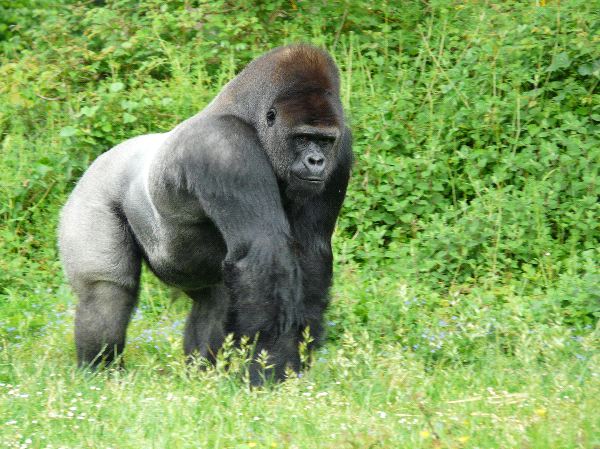
[Note: The silverback gorilla, pictured above, is vegan. I dare you to ask him where he gets his protein. :) ]